Thursday, 27 April 2017

Osprey Modelling Competition

A little while ago (mid march) I entered the monthly Osprey Modelling competition. The theme was 'Dark Ages' and as such I used some of my Romano-British figures as my entry. Below were my entries, I'm not sure which was used in the end. The Osprey Blog should showcase these next week (commencing May 1st, 2017) I have been informed.

My Dux/Comes
The Infantry

It turns out that I won! I was rather surprised as I thought my efforts distinctly average, especially in comparison with some of the fantastic figures seen online. Anyhow, my prizes finally arrived today and I'm quite chuffed with what I received. All of it rather interesting and useful to my wargaming/historical interests. I have not heard anything at all about the game Scrappers but I intend to have a good look through and see if it is suitable for my modern/near future Eastern European post -apoc needs.

https://ospreypublishing.com/blog/april_miniature_modelling_2017/

My Prizes!
With the Muskets and Tomahawks game fast approaching I have been finishing off the last few figures required. I have also been (finally) getting to grips with my 28mm WWII US Paras from Artizan. Compared to the 18th Century uniform the dull colours certainly make painting a lot easier and faster. Hopefully the reinforced platoon should be ready soon, pictures to follow.

Friday, 21 April 2017

Compagnies Franche de la Marine 400pt List

This is my 400 point list for the upcoming three way/two sided game of Muskets and Tomahawks. The force is formed around a core of Compagnies Franche de la Marine regulars with some irregular Marine/miltia support with a few Ottawa to round the numbers out.

The thoughts behind the force are quite simple; the line infantry are the decisive arm and to be used to deliver the important blows via volley. The militia to harass, redirect the enemies attempts. Finally the Indians for scouting and aiding with the harassment, due to their small numbers they can not stand up in a fight but can make a few shots. Hopefully the force can do reasonably well and isn't picked apart due to the larger blocks of Marines.


1x Compagnies Franche de la Marine Officer - Regular, Light Troop, Visionary      32

1x Compagnies Franche de la Marine Officer - Irregular, Light Troop, Inspiration    32

10x Compagnies Franche de la Marine                                                                     80

10x Compagnies Franche de la Marine                                                                     80

6x Canadian Militia w/native                                                                                       60                                                                                           
6x Canadian Militia w/native                                                                                       60

4x Indians                                                                                                                   28

4x Indians                                                                                                                   28

Total                                                                                                                          400
              
For the officers some background has been created using the TFL Sharp Practice character creator. This is not anything overly serious but more some limited characterisation and role play elements outside of the narrative tables at the rear of the rulebook. The names are as of yet undecided as nothing suitably amusing has come to mind.

Capitan
  • Military family but poverty stricken, a Gentleman
  • Honourable
  • Strapping fellow, fair face and affable
 A Canadian born fellow? would explain the relative poverty and military nature. Generally honourable makes for a good leader type character that cares about his men and useful for general interactions with natives/enemies.

Lieutenant
  • Nobility with wealth and influence
  • Rake
  • Average Build, Handsome devil, dullard
 A younger son sent away due to causing mischief in the family home/operations? interesting counter point to the Capitan.

Monday, 17 April 2017

Göteborg City Museum


Having spent this past Easter weekend in Gothenburg I have a few pictures from the City Museum. I found the museum exquisite; the building beautiful, the exhibits well organised and informative in contextualising the artefacts and Gothenburg as whole. The majority of the photographs below are from a military history perspective as befitting this blog but there may be a few others thrown in if I deem them interesting enough.

My knowledge of the artefacts pictured below is not that great and as I forgot to take notes/photographs of the details there will only be a brief description/thoughts. Just enjoy the pictures!

Bronze Age Weapons. What appears to be a 'Grip Tongue' type sword, A classic Bronze Age Spear
head and what I can only assume in a ceremonial axe head of some type.
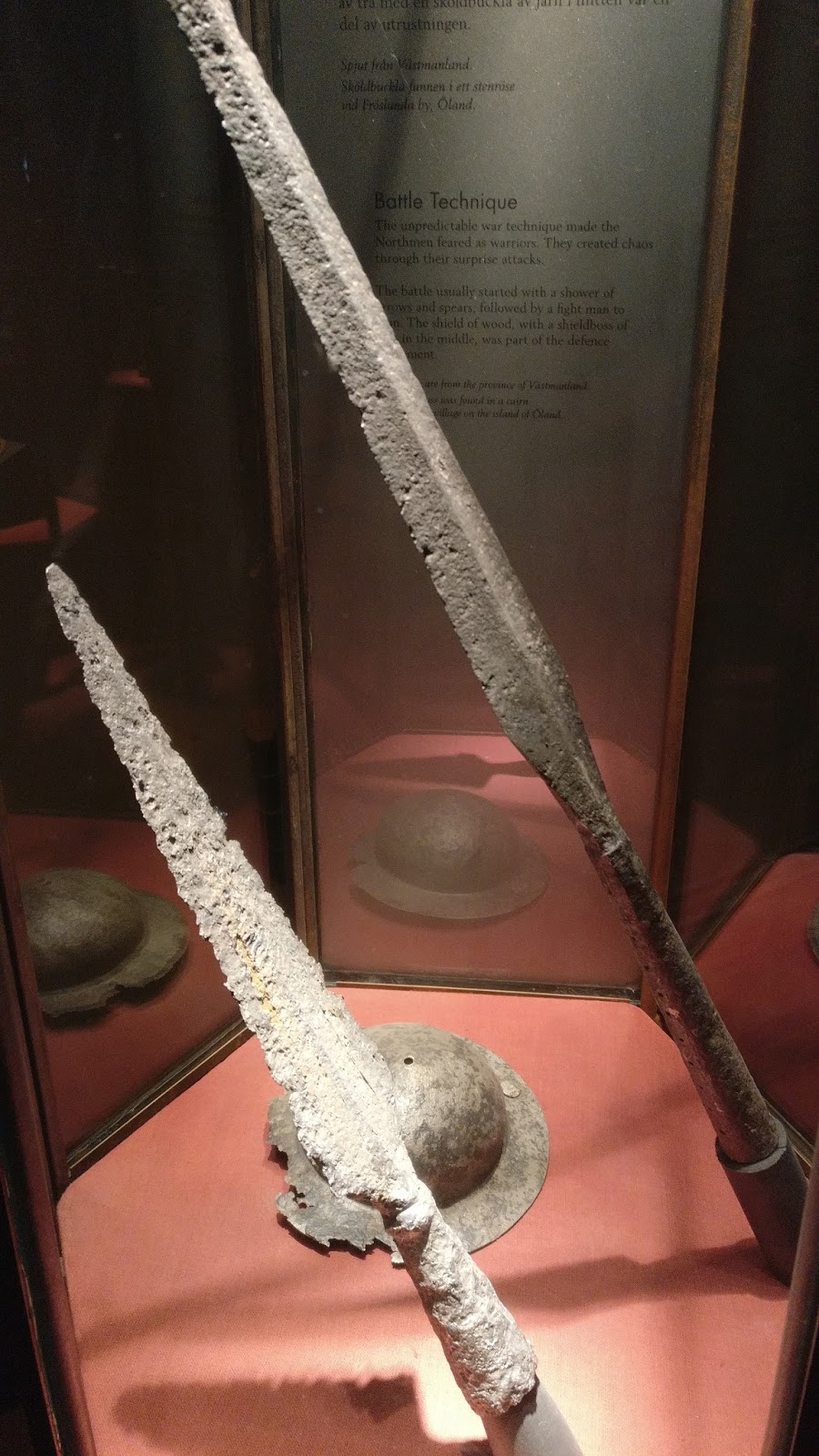
Two Early Medieval spear heads and a shield boss. I am
unsure whether these are Vendel or 'Viking' era.

A Dane Axehead, unsure of the date.

Three Swords, all of a different type dating from c700AD onwards.
A of Late C15th through to early C17th weapons and armour.

A of Late C15th through to early C17th weapons and armour including
caltrops and shot. I am unsure about the ceramic tiles and
why they were included in the display.

A Winged spear and a Swedish Morion/Pot
A very fine pair of flintlock pistols with ivory and gilt inlay.

17th Century wheelock arquebus.
A pair of 17th Century Swords. Right is a Swedish M1685 I believe. I am unsure
about the left example but it is earlier I think.
The equipment of a Gothenburg City Watchman
And finally, after all those poorly explained photographs comes something rather exciting. The only extant 'Viking' ship in Sweden! It is an exmaple of a Knarr, a trading vessel.


Monday, 6 March 2017

North American Blockhouse 2


Work continues on the blockhouse with the roof being tidied up (slightly) and most the paint work being completed. Some touch ups and refinements are required but it is taking its final shape. I tried for a weathered look to the timbers, I am not sure that I fully achieved this but they seem rather reasonable in tone. The base is painted in the same manner as the infantry (both the Indian, French and eventually British), While this makes the blockhouse seem rather dark when flocked etc it should be far better. I am reasonably happy with how the painting came out although the palisade made reaching certain point (especially under the fighting platform) rather difficult.

If I was to attempt the project again I believe keeping the block house separate from the palisade and base to facilitate easier painting. While it may make construction a little more tricky the effort saved in painting would more than make up for it.


The view inside the palisade and fighting platform. The door to the blockhouse itself can be clearly seen.

I have also attempted to tidy up the roof somewhat and while it is better than it was it is still not quite up to par. It will do for now, however I shall build a better, non rushed, version in the future. The base needs to be flocked and 'tufted', if there is such a word. I am undecided on what else to add to the base, as it is quite a large area and may look a little barren without something else. My British allied Indians (which are yet to be posted) have fallen/brown leaves due to the predominantly forested areas they would fight. It is tempting to to this for the blockhouse as well. However, I have yet to develop a method of placement that appears natural rather than odd clumps of leaves. I believe some practice and trial runs may be in order!


Sunday, 5 March 2017

North American Blockhouse

One of the key features of Colonial North America is the network of forts and defences along the frontiers. Some of these fortifications are massive and as such would take a great a deal of effort to create while only being able to be used within only the largest of games. What was more common, and far more usable in a wargaming sense, is a smaller outpost or blockhouse. Maybe such a structure is the refuge for a settlement or an outlying position for one of the larger forts? Either way it doesn't take up too much space on the table while giving that wild and frontier feel, it also gives a focal point to larger settlements.

The terrain piece has languished in a state of incompleteness for a number of years but I have resolved to finally see it finished. The blockhouse itself is a rather cheap and simple construction but one that I think is eminently usable. The pictures show the almost complete structure of the blockhouse and palisade.

The view from the front and entrance
The palisade and fighting platform

The doorway to the blockhouse.

As you can see, it's not the greatest construction. The roof is not very well done to be honest but is serviceable and can be tidied up in future. 

There are a number of things that still need to be completed before the Blockhouse is ready to be painted. The edges of the base sanded and bevelled as well as the top textured and sealed. The styrofoam stone work also needs to be sealed along with the balsawood planks.

Thursday, 2 March 2017

French and Indian War Beginnings

Once again my enthusiasm for my Empire army has trailed off, I was however happy with the amount that was achieved even within such a short period.  Instead I have diverted my attentions to the French and Indian War. There are two reasons for this: I absolutely love the period and have been working off and on for some years and that I have a game of Muskets and Tomahawks organised for May.

As stated I am very interested in 18th Century North America, mostly related to the French and Indian War (the name for the American theatre of the Seven Years War). The core reason for my interest, especially from a wargaming perspective, is the freedom that the period offers. Innumerably small actions can be fought using a wide range of figures whereby allowing for a great number of differing stories to be told. This strikes to the core of wargaming views; a method of telling stories, whether fictional or historical. This is combined with a love of the wilderness of colonial North America, the primordial forests which played and shaped the lives and warfare of those involved.

 This interest in the F&IW has manifested itself over the years in the formation of three wargaming forces. First of all my French. My most beloved force for the period and arguably the largest. This stems from a number of reasons generally related to siding with the underdog. If one is unaware the French colonies were large in area and very limited in manpower, roughly 75,000-80,000 settlers. The second is the Colonial Compagnies Franche de la Marine. I find these soldiers deeply fascinating, French enlisted recruits and (eventually) Canadian Officers useful as both light infantry manning the many forts in the vast Canadian/Louisiana/Ohio wildernesses as well as disciplined to conform to European methods, with the training and rigour to boot. This is coupled with a rather simple yet pleasing uniform and the option for a more relaxed frontier style of dress.

Compagnies Franche de la Marine in their normal European style Uniform. 
The drummer is in the standard colours of all French drummers (Michel Petard)
A break down showing the shirt, waistcoat, coat breeches and gaiters. 
Note the buff/brown belt. (Michel petard)

The above illustrations are partly what captivated my regarding Colonial Compagnies Franche de la Marine. I love the simplicity of the white/grey and the blue. The drawings themselves also having a certain style and panache helped as well.

With this in mind there are a few rules that we use or that I have used for other periods that overlap/ are suitable for the French and Indian War. Arguably the most popular and widely considered to be the modern classic for this period is Muskets and Tomahawks. With a relatively easy to use but yet with highly adaptable mechanics meaning that the battles scale well from rather small skirmishes with a handful of figures a side to larger games with regular firing lines and units. This combined with a robust narrative and random encounter system make the 6 or so scenarios contained within the book rather more varied. The only downside, and this is a rather personal opinion, is the lack of a campaign system regarding troops, experience/morale etc. These can be easily house ruled but I would have liked an 'official' system, possible with expansion random encounters and talents.

There are however are great number of other games that cover the French and Indian War or Black Powder periods in general that can be adapted/have supplements or expansion suitable. These games also cover different scales of combat ranging from individuals or small groups to large battles and sieges.

The two smallest scale games that I know and have played are Song of Drums and Tomahawks (a variation of the very popular Song of Blades and Heroes franchise) and Long Rifle. While focused on a smaller skirmish wargame both take rather different approaches. Song of Drums and Tomahawks is your standard 5-10 figure aside skirmish game, infinitely familiar to those who already know Song of... games. This is not to suggest it is a poor game merely that it is immediately accessible. Long Rifle, in contrast, has a great deal more RPG elements as well as greater reaction and morale mechanics. Long Rifle is also designed with solo play in mind and is most definitely campaign focused, it being inherent to the development of your character.

Sharp Practice  fills a similar niche to Muskets and Tomahawks in terms of game size. It is, however, eminently more restrictive in terms of force composition due to the fixed nature of unit sizes. Sharp Practice also lends itself to more regular actions, although it is capable of doing skirmishes or irregular battles as well. The background designer is wonderful at adding character to your officers and developing their actions throughout a game/campaign. It does the same as Muskets and Tomahawks' optional objectives albeit with a more concrete and structured mechanic. There is currently no official campaign structures other than linking scenarios and devising them yourselves but hopefully there will be an expansion release at some point in the future.

Hopefully this gives a reasonable introduction to my thoughts in regards to the F&IW. In the coming days or weeks there will be some photographs of my collections and terrain developments as well as the plans I have relating to the upcoming games in May.

Wednesday, 15 February 2017

Nordland Halberdiers

  A few photographs of my work in progress Empire halberdiers. The figures are from Artizan Designs with a few Citadel pieces (the Standard and halberd heads). The hafts are made from 1.2mm plastic rod, any larger and it would have seemed unwieldy. Overall I am quite happy with the finished unit. As of now they have been scraped and cleaned some more and finally undercoated.


I also received another unit of 20 Landsknechts that will be pikemen/spearmen. While they are assembled and based in the same manner as the halberdiers I have no photographs to share.

In other news the Mordheim campaign has begun and during which Heinrich's Heroes lost their first game rather dramatically. Having suffered five out of actions which resulted in the death of one witch hunter, one witch hunter being sold to the pits and losing against the pit fighter and the loss of one warhound. In turn the opponents suffered one out of action, a dwarf slayer. This is despite the heroic actions of the warrior priest managing to knock down and stun the Dwarf thane twice. Overall it was not a great time for the band but a few figures at least got some experience which hopefully with another game will lead to greater things.